turnkey automated assembly line manufacturers: Explore Modern Production Systems
Manufacturing operations increasingly depend on coordinated automation to maintain consistent production, reduce process variation, and manage increasingly complex product requirements. Turnkey automated assembly line manufacturers play a central role in this shift by bringing together equipment, controls, software, robotics, and production workflows into integrated systems.
Unlike projects where individual machines are developed and installed separately, a turnkey approach typically covers multiple stages of an automation project. Engineering, equipment integration, programming, testing, installation, and commissioning can be coordinated as part of a broader production system.
Understanding how these manufacturers approach automated assembly provides useful insight into modern factory design. It also helps manufacturers recognize the technical decisions that influence flexibility, quality control, throughput, maintenance, and long-term operational performance.
How Turnkey Assembly Systems Are Designed
A turnkey automated assembly line begins with the product, production process, and desired operating requirements rather than with a particular machine. Engineers first study how components move through the process, where assembly operations occur, and which activities require automation.
This initial evaluation often includes cycle-time requirements, product dimensions, assembly tolerances, operator interaction, material flow, inspection needs, and future production scenarios. The objective is to create a system architecture in which mechanical and digital elements work together rather than functioning as isolated machines.
Manufacturers may then develop the line layout, select automation technologies, define control architecture, and determine how different stations will communicate. This planning stage has a major influence on the eventual efficiency and maintainability of the production line.
What a Modern Automated Assembly Line Contains
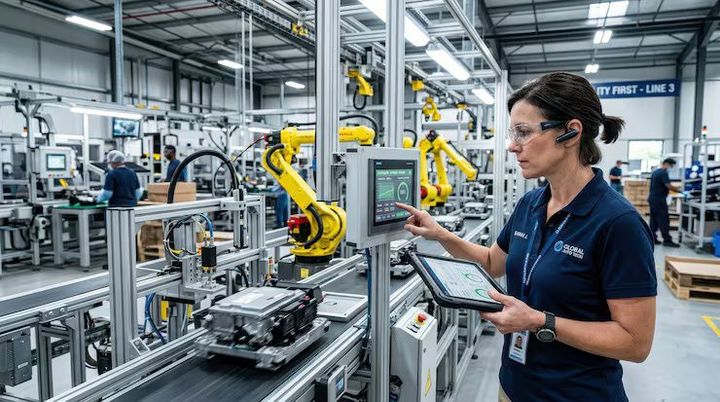
A complete assembly system can combine several technologies, depending on the manufacturing process. Mechanical handling equipment establishes the physical movement of products, while sensors and controllers coordinate each operation.
Common elements include:
- Conveyors and indexing systems
- Robotic assembly cells
- Servo-driven motion systems
- Pneumatic actuators
- Industrial vision systems
- Programmable logic controllers
- Human-machine interfaces
- Safety controllers and guarding
- Automated inspection equipment
- Traceability and data collection systems
Not every project requires all of these technologies. The appropriate combination depends on product complexity, assembly sequence, precision requirements, and production volume.
The Role of Robotics and Motion Control
Robotics can perform repetitive assembly activities with consistent positioning and timing. Applications may include component insertion, fastening, dispensing, pick-and-place operations, machine tending, and material handling.
Servo motors and precision motion controllers complement robotics by providing controlled movement where speed and positioning accuracy are important. These systems can coordinate several axes simultaneously and adjust movement profiles according to production requirements.
The real value comes from integration. Robots, feeders, conveyors, vision systems, and controllers must exchange information correctly for a station to function reliably. A robot that operates accurately in isolation does not guarantee a reliable assembly process if upstream or downstream equipment is poorly synchronized.
Machine Vision and Automated Inspection
Quality control is increasingly integrated directly into assembly lines rather than being treated as a separate final-stage activity.
Machine vision systems can inspect components, verify orientation, detect missing parts, compare dimensions, and confirm assembly conditions. These systems use cameras and image-processing software to evaluate products against predefined criteria.
Automated inspection can identify process deviations earlier, helping prevent defective assemblies from progressing to later stages. In applications with tight quality requirements, vision systems can also create inspection records that support traceability and process analysis.
Controls and Software Integration
The control system acts as the operational framework connecting equipment throughout the production line. Programmable logic controllers coordinate sensors, actuators, motors, robots, safety devices, and other automation components.
Human-machine interfaces give operators access to machine status, alarms, production information, and controlled operating functions. More advanced systems may connect production equipment with manufacturing execution systems or other factory information platforms.
Software therefore becomes an important part of turnkey automation. Reliable programming, clear fault handling, data structures, and diagnostic capabilities can make the difference between a system that is merely automated and one that is manageable in daily production.
Safety Must Be Built Into the System
Automated assembly lines involve moving machinery, electrical equipment, pneumatic systems, robots, and other potential hazards. Safety engineering therefore needs to be considered during system design rather than added after the equipment has been built.
Manufacturers may incorporate physical guarding, emergency stops, safety interlocks, light curtains, safety scanners, and monitored access points according to the requirements of the application.
Relevant standards and regulatory requirements depend on the jurisdiction and machine category. In many industrial environments, frameworks such as ISO 12100 for machinery risk assessment and IEC 60204-1 for electrical equipment of machines provide important reference points.
Safety validation should consider normal production as well as maintenance, setup, troubleshooting, and recovery conditions.
Factory Acceptance Testing and Commissioning
Testing is a critical part of turnkey automation because the line must demonstrate that its integrated components work as intended.
Factory acceptance testing, commonly referred to as FAT, is generally performed before shipment or final installation. The system may be evaluated for sequence control, cycle behavior, safety functions, inspection logic, alarms, and other agreed technical requirements.
After installation, commissioning verifies performance in the actual production environment. This stage can reveal issues associated with utilities, material presentation, plant layout, environmental conditions, or interactions with existing equipment.
A structured testing process provides an opportunity to resolve integration problems before regular production begins.
Designing for Flexibility and Future Changes
Manufacturing requirements rarely remain static. Product variants may change, production volumes can shift, and new quality requirements may emerge. A rigid automation system can become difficult to adapt when these changes occur.
For this reason, turnkey assembly line manufacturers often consider modular equipment architecture, programmable recipes, adjustable tooling, flexible feeding systems, and scalable controls during the design process.
Changeover time is another important consideration. A line that can accommodate multiple product variants with controlled adjustments may provide greater operational flexibility than a system optimized for only one fixed configuration.
Maintenance and Lifecycle Considerations
The success of an automated line cannot be measured only by whether it works when first installed. Long-term reliability depends on maintainability, spare components, diagnostics, documentation, and technician access.
Good system design makes frequently serviced components accessible and provides useful fault information when problems occur. Diagnostic screens can help maintenance personnel identify the source of an issue without manually examining every station.
Documentation also matters. Electrical drawings, software backups, component specifications, maintenance procedures, and equipment manuals provide essential references throughout the operational life of the system.
Choosing a Turnkey Automation Approach
When evaluating turnkey automated assembly line manufacturers, technical capability should be assessed alongside project management and integration experience.
Important areas to examine include:
- Experience with similar assembly processes
- Mechanical and electrical engineering capability
- Robotics and controls expertise
- Machine vision integration
- Safety engineering practices
- Testing and commissioning procedures
- Documentation and training
- Support for future modifications
A strong manufacturer should be able to explain not only what equipment will be installed, but also how the complete production process will operate as an integrated system.
Frequently Asked Questions
What does turnkey automation mean in manufacturing?
Turnkey automation generally refers to an integrated project in which a manufacturer or automation integrator manages major stages such as engineering, equipment development, controls, testing, installation, and commissioning.
Which industries use automated assembly lines?
Automated assembly systems are used across industries such as automotive, electronics, medical equipment, consumer products, industrial machinery, and other sectors involving repetitive or highly controlled assembly processes.
Are turnkey assembly lines fully automated?
Not necessarily. Some systems are fully automated, while others combine robots and automated equipment with human operators for tasks that require judgment, replenishment, inspection, or flexible handling.
Why is machine vision used in assembly automation?
Machine vision can verify component presence, orientation, positioning, dimensions, or other quality characteristics. It provides automated inspection and can help detect process deviations during production.
What happens after an automated assembly line is installed?
After installation, the system typically undergoes commissioning and production validation. Controls, safety functions, equipment coordination, quality checks, and process performance are evaluated under actual operating conditions.
Conclusion
Turnkey automated assembly line manufacturers bring mechanical engineering, robotics, controls, inspection technologies, software, and production planning together within a coordinated manufacturing system. This integrated approach can simplify complex automation projects while providing a clearer path from initial process design to operational commissioning.
The strongest systems are not defined by the number of robots or automated devices they contain. Their effectiveness comes from thoughtful process engineering, reliable integration, appropriate safety measures, efficient inspection, flexible controls, and practical lifecycle planning. As manufacturing environments become more connected and demanding, these principles remain central to building dependable modern production systems.